
The Bitter Secret of Aloe Ferox: From Golden Sap to Dark Crystals
From Golden Sap to Dark Crystals: The Remarkable Story of a South African Botanical
There's something rather beautiful about a plant that keeps its most interesting qualities hidden.
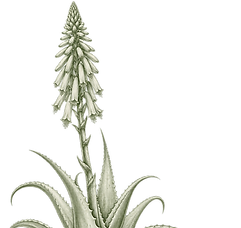
At first glance, Aloe ferox is all sharp edges and fiery flowers. It rises from the South African landscape with an almost stubborn dignity, its enormous leaves armed with reddish spines and its spectacular orange blossoms reaching toward the sky.
Nothing about it suggests softness.
Yet beneath that formidable exterior lies an extraordinary botanical story. When a leaf is cut, a golden-yellow liquid begins to emerge. Intensely bitter, this liquid has been gathered for generations and transformed through a traditional process into something almost unrecognizable: dark, glass-like Aloe ferox crystals.
I find these transformations endlessly fascinating. They remind me that plants have lives and histories far more complicated than the little jars, bottles, and packages we eventually discover them in.
And the story of Aloe ferox is particularly captivating.
A Fierce Beauty of the South African Landscape
The name itself tells us something about the character of this plant.
Ferox is Latin for fierce, which seems especially appropriate for an aloe that looks as though it has absolutely no intention of being touched.
Unlike the smaller aloe plants that sit comfortably on sunny windowsills, Aloe ferox can develop a substantial stem crowned with an enormous rosette of thick, thorny leaves. Mature plants stand like botanical sentinels across parts of southern Africa.
But it's when the plant flowers that it truly steals the show.
Imagine great branching candelabras of orange and scarlet blossoms rising above those formidable leaves. In South Africa, Aloe ferox generally flowers during the cooler months, bringing unexpected color to the winter landscape.
And the birds know exactly when to visit.
The nectar-rich flowers attract a variety of feathered visitors, creating a wonderful contrast: a fiercely defended plant offering nourishment to creatures delicate enough to perch among its blossoms.
I love that contradiction. Plants are so rarely just one thing.
And while those brilliant flowers are the part most likely to catch our attention, the leaves hold a secret that has fascinated people for centuries.
The Golden Secret Hidden Inside an Aloe Leaf
When most people hear the word aloe, they immediately picture the familiar transparent gel used in skincare.
But inside an aloe leaf are different tissues, and they produce very different substances.
The thick, fleshy interior contains the clear, slippery gel. Nearer the green outer rind are specialized cells associated with a yellow, intensely bitter liquid often called aloe latex or leaf exudate.
Although these materials come from the same plant, they are not interchangeable.
The inner gel is familiar from cosmetic and moisturizing products. The bitter exudate, on the other hand, contains naturally occurring compounds called anthranoids, including aloin, which have a markedly different physiological activity.
What fascinates me is that these two substances can exist so close to each other while being so different in character.
One is transparent, mild in appearance, and predominantly watery.
The other is golden, intensely bitter, and rich in compounds that have made it valuable in traditional herbal preparations.
And it was this second substance that became the foundation of an extraordinary South African botanical tradition.
The Old Art of Collecting the Golden Sap
Picture a hillside where mature Aloe ferox plants have spent years growing beneath the African sun.
The traditional harvest is not simply a matter of cutting down a plant and extracting everything it contains.
Instead, experienced harvesters remove selected lower leaves from mature plants. The freshly cut leaves are carefully arranged in a circle around a shallow collection basin, with their cut ends facing inward.
It is a beautifully practical arrangement.
The leaves form a prickly ring, allowing the bitter liquid to drain into the center.
This traditional process is known as aloe tapping.
I find something particularly appealing about the ingenuity of it. There's no elaborate machinery in the essential method, just a deep understanding of the plant, its structure, and the way its sap behaves when the leaf is cut.
Of course, it's demanding work. The leaves are large, heavy, and armed with sharp spines.
For generations, people in South Africa have developed and passed down the knowledge needed to harvest this material.
The liquid that collects is usually yellow to brownish and extraordinarily bitter. It is quite unlike the clear aloe gel most people recognize.
And at this point, its transformation has only just begun.
From Golden Sap to Dark Aloe Ferox Crystals
This is perhaps the most surprising part of the story.
Once the bitter leaf exudate has been collected, it is traditionally heated to remove much of its water.
As the liquid becomes more concentrated, it thickens and darkens. After cooling, the material solidifies into a hard, dark brown or almost black mass.
This concentrated material is traditionally known as Cape aloe bitters, Cape aloes, or aloe lump. The broken, glass-like pieces are also commonly described as Aloe ferox crystals.
The word crystals can be a little misleading. These aren't necessarily the perfectly shaped mineral crystals we might imagine. They are often irregular, brittle, and glossy, with amber-brown translucence visible along thinner edges.
Their appearance is striking.
A liquid that began as a golden exudate has become a deep brown, almost black solid.
It's difficult to imagine two substances looking more different, yet both represent stages in the preparation of the same botanical material.
For me, this is where the story becomes especially beautiful.
We often think of plants as something fixed: a leaf, a flower, a seed, a root. But the materials they produce can undergo extraordinary changes through careful collection and processing.
What begins in the living leaf can take on an entirely different appearance once separated, concentrated, and preserved.
A Botanical Tradition With a Long History
The history of Cape aloe is also the history of the people who have worked with it.
Aloe ferox has long been valued in southern Africa, and records of Cape aloe exports date back to 1761.
Think about that for a moment.
Long before modern botanical packaging, online shops, or the popularity of aloe-based wellness products, this remarkable plant was already part of an established international trade.
Its bitter extract traveled far beyond the landscape in which it originated.
Today, Aloe ferox harvesting continues to support livelihoods in parts of South Africa, particularly in the Eastern and Western Cape.
But there's another side of this story worth remembering.
Many commercial Aloe ferox products still begin with plants harvested from the wild. Responsible harvesting, protection of natural populations, and fair treatment of the people involved are therefore important parts of the botanical's future.
I think appreciating a plant means appreciating the landscape it belongs to and the hands that have learned how to work with it.
A botanical product becomes much more meaningful when we understand the living world behind it.
Why Bitter Aloe Is Different From Ordinary Aloe Vera
There's one important distinction I'd like to make before we leave the subject.
The words natural and gentle are often treated as though they mean the same thing.
But anyone who spends time learning about plants soon discovers that nature is far more complicated than that.
Aloe ferox bitters contain physiologically active compounds, including aloin. Preparations containing these compounds have traditionally been used for their stimulant-laxative properties.
That activity is very different from the familiar cosmetic uses of clear aloe gel.
It also means bitter aloe preparations require caution. Oral aloe latex can cause abdominal cramps and diarrhea, and unsuitable or prolonged use can carry additional risks. It is not appropriate for everyone.
The fact that a plant has a long history of traditional use does not automatically make every preparation safe for everyday consumption.
Personally, I think understanding these distinctions makes the botanical world more interesting, not less.
Plants deserve to be appreciated for what they truly are, rather than for what we would simply like them to be.
The Beauty of Looking a Little Closer
The next time you come across a piece of dark Cape aloe crystal, perhaps you'll see something more than an unusual botanical ingredient.
\
You might picture a rugged South African hillside.
A towering aloe crowned with scarlet flowers.
Birds gathering around its blossoms in the cool winter air.
The freshly cut leaves arranged in a circle, slowly releasing their golden bitterness.
And the patient transformation of that liquid into a dark, glass-like material.
It's these hidden stories that make the plant world so endlessly captivating to me.
Every leaf has a history, every flower has a purpose, and sometimes the most remarkable discoveries begin with something we have looked at a hundred times without ever really seeing.
Aloe ferox is a beautiful reminder that there's always more to discover, particularly when we take the time to look a little closer.
With a little more wonder for the botanical world,
The Botanical Journal
Ancient Roots Botanicals
A note on botanical safety: This article explores the history and traditional preparation of Aloe ferox. It is intended for educational purposes, not as instructions for preparing or consuming aloe latex. Bitter aloe products can have significant physiological effects and should only be considered with appropriate professional guidance.